
Category: How Alpha Works Text
-
3. Stacking
3. Stacking Once trapped it is now possible to repeat the procedures of mixing and trapping, but without de-energising the magnetic trap after each repeat. This means that one can continuously add new antihydrogen atoms to the trap, losing only a few due to their naturally short lifetime in a world of normal matter. The
-
2. Trapping of Antihydrogen
2. Trapping of Antihydrogen Antihydrogen is electrically neutral, so it cannot be confined with the combination of electric and magnetic fields that confine the charged positrons and antiprotons. Antihydrogen does however have a magnetic “dipole moment”, which means that it can be confined using an arrangement of magnetic fields. The dipole moment is a very
-
1. Mixing of Antiprotons & Positrons
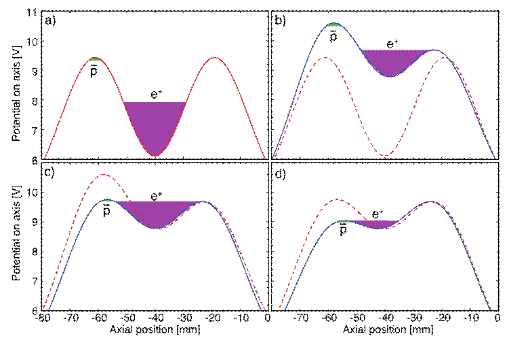
1. Mixing of Antiprotons & Positrons Antihydrogen is synthesized by merging ensembles of antiprotons and positrons. As the goal is to trap them, it is of utmost importance that the antihydrogen synthesized is cold enough to be trapped. The magnetic trap used to trap them is at best around 50 micro-electron-volt deep; this is equivalent
-
Antiproton Capture
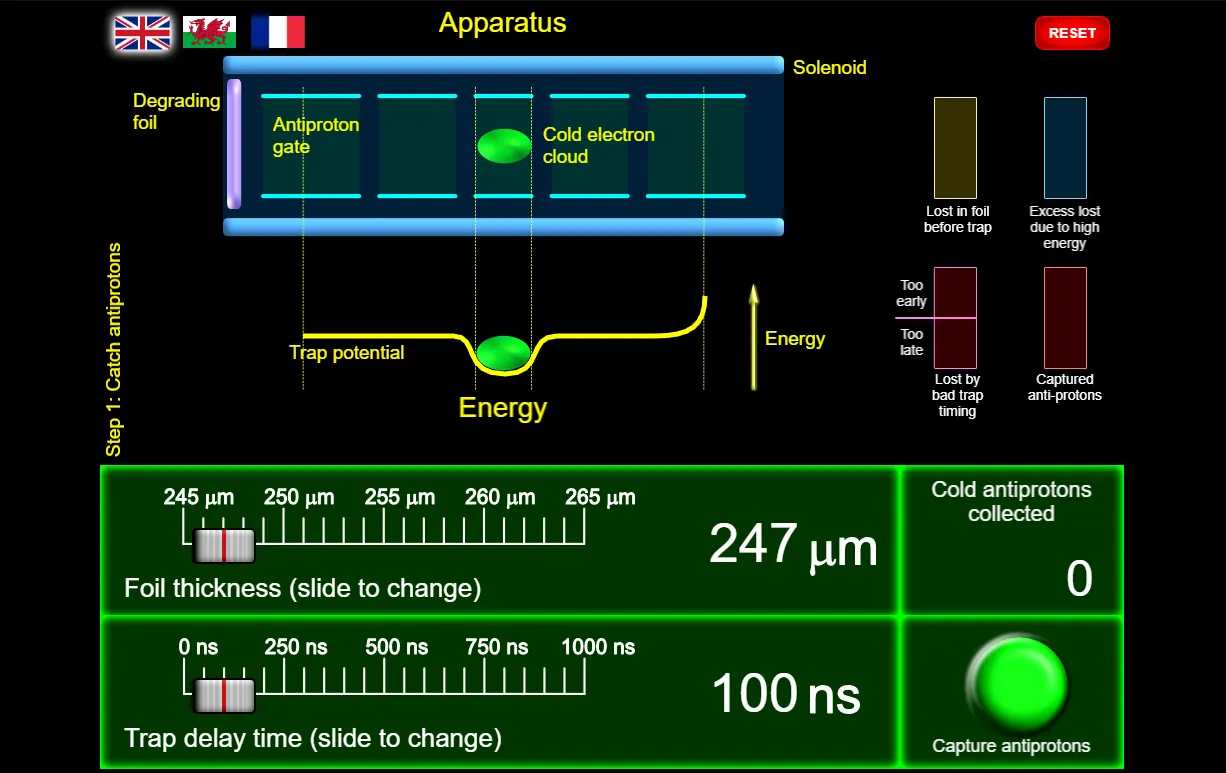
Antiproton Capture In order to give you an idea of how antihydrogen is actually made and trapped, we have made a small game that takes you through some key steps. You must succeed at each step to progress to the next. In the first part you need to capture antiprotons from the AD. The animation
-
Antiproton Source
Antiproton Source From Beam to Particle Why decelerate? In order to make (anti)matter from “nothing” you need as a minimum the energy given by Einstein’s famous formula E=mc2. In practice you need somewhat more to make the process efficient. Antiproton production therefore requires high energy (10s of GeV) collisions (proton beam onto a metal target),
-
Positron Accumulation
Positron Accumulation The Positron Accumulator has a trap composed of a 0.14 T solenoid magnet and 7 cylindrical electrodes. The first two electrodes are narrow, with a diameter of 12.7 mm each. The third electrode has a diameter of 30.5 mm, and the last four electrodes are the widest, at 200.7 mm each. Pure nitrogen
-
Positron Source
Positron Source Positrons in ALPHA originate from a radioactive isotope of sodium Na-22. The Na-22 source is manufactured at iThemba Labs in Cape Town, South Africa and then shipped in a special container to CERN following international protocols for the transport of radioactive substances. Na-22 has a long half-life of 2.6 years, and therefore emits