
Tag: Trap
-

Optimization of Antiproton Capture and Delivery for the ALPHA Antihydrogen Experiment
The ALPHA (Antihydrogen Laser PHysics Apparatus) collaboration at CERN is testing Charge-Parity-Time (CPT) symmetry through precise measurements with antihydrogen atoms and in the future will measure antihydrogen’s free fall acceleration in Earth’s gravitational field. The antihydrogen atoms are created by slowly merging cold plasmas of antiprotons and positrons. The production rate is highly sensitive to
-
Ioffe-Pritchard Trap
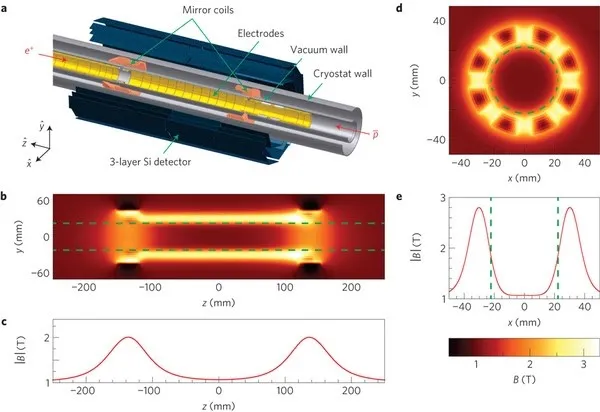
Ioffe-Pritchard Trap The ALPHA magnetic trap is a variant of a type of atom trap called an ‘Ioffe trap’. a A schematic view of the ALPHA trap. Radial and axial confinement of antihydrogen atoms is provided by an octupole magnet (not shown) and mirror magnets, respectively. Penning trap electrodes are held at ~9 K, and
-
Penning Trap
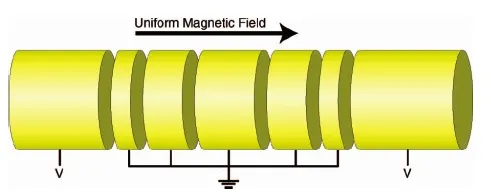
Penning Trap It is a basic and unavoidable fact in the antimatter business that in order to produce antihydrogen, antiprotons and positrons must be mixed. So, ALPHA must have the ability to confine and manipulate charged plasmas with reasonable efficiency and at cryogenic temperatures to boot! This is accomplished in ALPHA through the use of
-
Plastic Scintillators
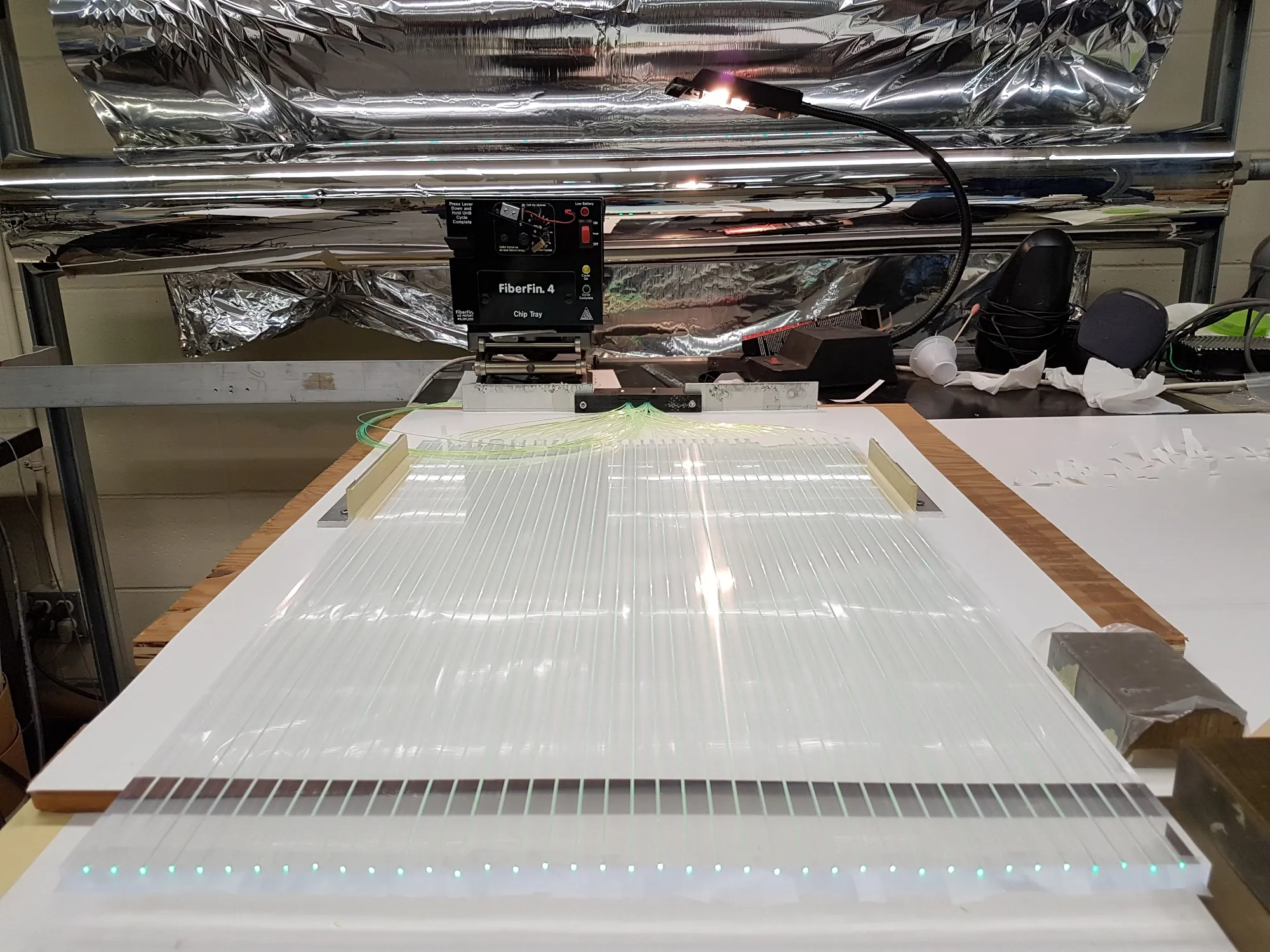
Plastic Scintillators The manipulations of an antiproton plasma can be easily monitored using particle detectors, such as plastic scintillators. They are the most common type of detector encountered in particle and nuclear physics. Owing to their fast response (of the order of a few nanoseconds), they are ideal to observe the annihilation of antiprotons while
-
Atom Trap
Atom Trap With a combination of magnets, we can hold antihydrogen in our apparatus without touching it
-
Penning Trap
Penning Trap The charged particle trap, capable of holding electrons, positrons and antiprotons in a vacuum.
-
Traps
Traps In order to study antimatter, we need to hold it without touching it with matter. We have various traps to hold the various ingredients needed for making antihydrogen in a vacuum.
-
10. Release antihydrogen
10. Release antihydrogen Turn of the atom trap to see what’s left over Related physics: Annihilation, Detectors Related equipment: SVC, TPC, Atom Trap
-
4. Cool and compress antiprotons
4. Cool and compress antiprotons (with electrons) Related physics: Plasma physics, electron cooling, rotating wall, evaporative cooling, SDREVC (rotating wall with evaporative cooling) Related equipment: Penning Trap
-
3. Catch antiprotons
3. Catch antiprotons Related physics: Penning Trap Related equipment: Catching Trap, Penning Trap