
Tag: Publication
-

Progress towards microwave spectroscopy of trapped antihydrogen
Precision comparisons of hyperfine intervals in atomic hydrogen and antihydrogen are expected to yield experimental tests of the CPT theorem. The CERN-based ALPHA collaboration has initiated a program of study focused on microwave spectroscopy of trapped ground-state antihydrogen atoms. This paper outlines some of the proposed experiments, and summarizes measurements that characterize microwave fields that
-
Trapped Antihydrogen
Precision spectroscopic comparison of hydrogen and antihydrogen holds the promise of a sensitive test of the Charge-Parity-Time theorem and matter-antimatter equivalence. The clearest path towards realising this goal is to hold a sample of antihydrogen in an atomic trap for interrogation by electromagnetic radiation. Achieving this poses a huge experimental challenge, as state-of-the-art magnetic-minimum atom
-
Detection Of Trapped Antihydrogen
The ALPHA experiment is an international effort to produce, trap, and perform precision spectroscopic measurements on antihydrogen (the bound state of a positron and an antiproton). Based at the Antiproton Decelerator (AD) facility at CERN, the ALPHA experiment has recently magnetically confined antihydrogen atoms for the first time. A crucial element in the observation of
-
The Effect Of Multipole-Enhanced Diffusion On The Joule Heating Of A Cold Non-Neutral Plasma
One proposed technique for trapping anti-atoms is to superimpose a Ioffe-Pritchard style magnetic-minimum neutral trap on a standard Penning trap used to trap the charged atomic constituents. Adding a magnetic multipole field in this way removes the azimuthal symmetry of the ideal Penning trap and introduces a new avenue for radial diffusion. Enhanced diffusion will
-
Confinement of antihydrogen for 1,000 seconds
Atoms made of a particle and an antiparticle are unstable, usually surviving less than a microsecond. Antihydrogen, made entirely of antiparticles, is believed to be stable, and it is this longevity that holds the promise of precision studies of matter–antimatter symmetry. We have recently demonstrated trapping of antihydrogen atoms by releasing them after a confinement
-
Towards antihydrogen trapping and spectroscopy at ALPHA
Spectroscopy of antihydrogen has the potential to yield high-precision tests of the CPT theorem and shed light on the matter-antimatter imbalance in the Universe. The ALPHA antihydrogen trap at CERN’s Antiproton Decelerator aims to prepare a sample of antihydrogen atoms confined in an octupole-based Ioffe trap and to measure the frequency of several atomic transitions.
-
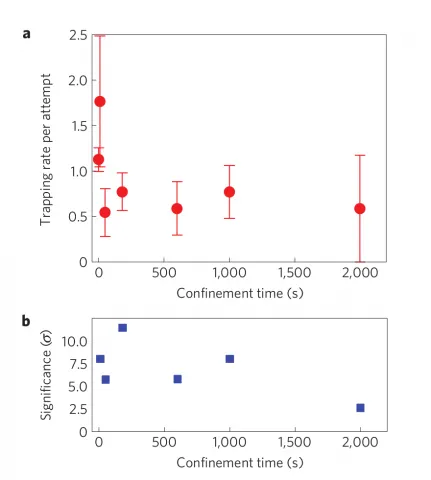
Antihydrogen Atoms trapped for 1000s
In a paper published online at Nature Physics, ALPHA announces confinement of antihydrogen atoms for at least 1000s. Last November, we announced in Nature that we had successfuly trapped 38 antihydrogen atoms for at least 172 ms. In fact, 172 ms is the shortest time we can trap atoms and be sure that we’ve removed
-
Antihydrogen Formation, Dynamics And Trapping
Antihydrogen, the simplest pure-antimatter atomic system, holds the promise of direct tests of matter-antimatter equivalence and CPT invariance, two of the outstanding unanswered questions in modern physics. Antihydrogen is now routinely produced in charged-particle traps through the combination of plasmas of antiprotons and positrons, but the atoms escape and are destroyed in a minuscule fraction
-
ALPHA Collaboration gets Antihydrogen in the Trap
The ALPHA collaboration has achieved one of the long-stated goals of the physics programme at CERN’s Antiproton Decelerator: magnetic trapping of antihydrogen atoms. Go directly to
-
Centrifugal Separation and Equilibration Dynamics in an Electron-Antiproton Plasma
Charges in cold, multiple-species, non-neutral plasmas separate radially by mass, forming centrifugally separated states. Here, we report the first detailed measurements of such states in an electron-antiproton plasma, and the first observations of the separation dynamics in any centrifugally separated system. While the observed equilibrium states are expected and in agreement with theory, the equilibration