
Tag: Publication
-

Tests Of Fundamental Symmetries With Trapped Antihydrogen
Antihydrogen is the simplest pure antimatter atomic system, and it allows for direct tests of CPT symmetry as well as the weak equivalence principle. Furthermore, the study of antihydrogen may provide clues to the matter- antimatter asymmetry observed in the universe – one of the major unanswered questions in modern physics. Since 2010, it has
-
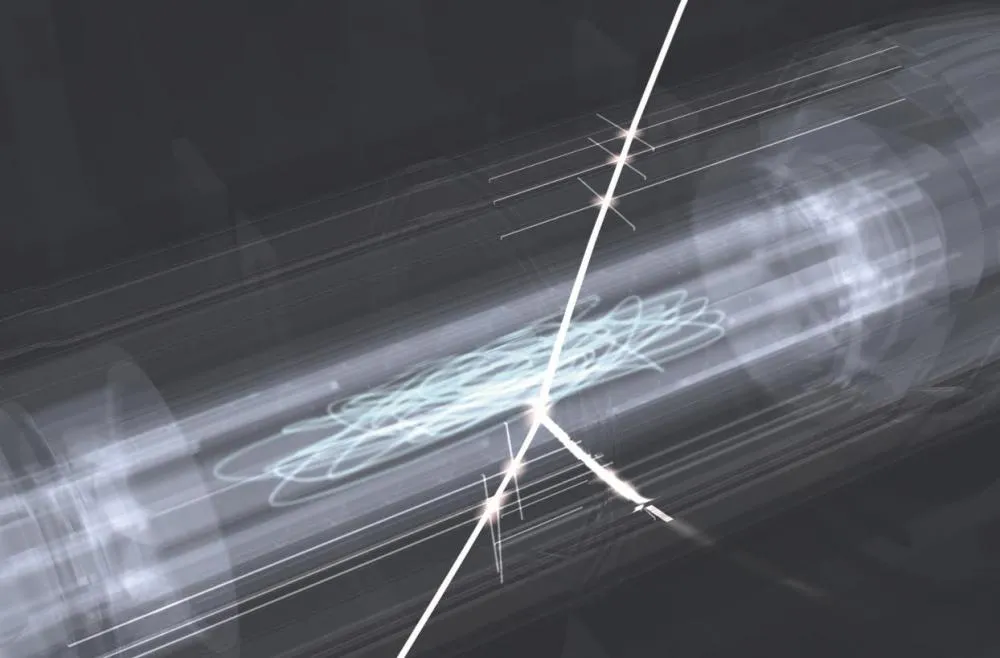
Observation of the 1S-2S Transition in Trapped Antihydrogen published in Nature
Our latest breakthrough, the first observation of the 1S-2S transition in trapped antihydrogen has been published in Nature and is the first time a spectral line has been observed in antihydrogen. This builds on years of work, developing techniques to manipulate super-cold antiprotons and positrons, create trapped antihydrogen and detect the very few atoms that
-
Cold Antihydrogen Experiments And Radial Compression Of Antiproton Clouds In The ALPHA Apparatus At CERN
Antihydrogen is the simplest neutral antimatter atom. Precision comparisons between hydrogen and antihydrogen would provide stringent tests of CPT (charge conjugation/parity transformation/time reversal) invariance and the weak equivalence principle. In the last few years, the ALPHA collaboration has produced, and trapped antihydrogen [1, 2]. Most recently, this collaboration has probed antihydrogen’s internal structure by inducing
-
Observation of the 1S-2S transition in trapped antihydrogen
We report the observation of the 1S-2S transition in magnetically trapped atoms of antihydrogen in the ALPHA-2 apparatus at CERN. We determine that the frequency of the transition, driven by two photons from a frequency stabilised laser at 243 nm, is consistent with that expected for hydrogen in the same environment. This represents the first
-
Antiproton cloud compression in the ALPHA apparatus at CERN
We have observed a new mechanism for compression of a non-neutral plasma, where antiprotons embedded in an electron plasma are compressed by a rotating wall drive at a frequency close to the sum of the axial bounce and rotation frequencies. The radius of the antiproton cloud is reduced by up to a factor of 20
-
An improved limit on the charge of antihydrogen from stochastic acceleration
Antimatter continues to intrigue physicists because of its apparent absence in the observable Universe. Current theory requires that matter and antimatter appeared in equal quantities after the Big Bang, but the Standard Model of particle physics offers no quantitative explanation for the apparent disappearance of half the Universe. It has recently become possible to study
-
Physics with antihydrogen
Performing measurements of the properties of antihydrogen, the bound state of an antiproton and a positron, and comparing the results with those for ordinary hydrogen, has long been seen as a route to test some of the fundamental principles of physics. There has been much experimental progress in this direction in recent years, and antihydrogen
-
Testing CPT and antigravity with trapped antihydrogen at ALPHA
High precision antihydrogen experiments allow tests of fundamental theoretical descriptions of nature. These experiments are performed with the ALPHA apparatus, where ultra-low energy antihydrogen is produced and confined in a magnetic trap. Antihydrogen spectroscopy is of primary interest for precision tests of CPT invariance – one of the most important symmetries of the Standard Model.
-
Antiproton And Positron Dynamics In Antihydrogen Production
The asymmetry between matter and antimatter in the universe and the incompatibility between the Standard Model and general relativity are some of the greatest unsolved questions in physics. The answer to both may possibly lie with the physics beyond the Standard Model, and comparing the properties of hydrogen and antihydrogen atoms provides one of the
-
Studies On The Neutrality Of Antihydrogen
The recent demonstration of trapping of antihydrogen atoms by the ALPHA collaboration at CERN opened great possibilities to study antimatter and perform precision measurements on it. In this work, a retrospective analysis of the 2010 and 2011 experimental runs in ALPHA, together with comprehensive studies of the apparatus and detailed simulations of the manipulations of