
Tag: Theses
-

Sympathetically Laser-Cooled Positron Plasmas for Antihydrogen Formation
Answering the question of why we live in a matter-dominated universe is of great interest to contemporary physicists, as the Standard Model of Particle Physics predicts that matter and antimatter should only ever be produced in equal parts. Antihydrogen is a good candidate for searches for asymmetries between matter and antimatter as it is the
-
Optimization of Antiproton Capture and Delivery for the ALPHA Antihydrogen Experiment
The ALPHA (Antihydrogen Laser PHysics Apparatus) collaboration at CERN is testing Charge-Parity-Time (CPT) symmetry through precise measurements with antihydrogen atoms and in the future will measure antihydrogen’s free fall acceleration in Earth’s gravitational field. The antihydrogen atoms are created by slowly merging cold plasmas of antiprotons and positrons. The production rate is highly sensitive to
-
Sympathetic cooling of positrons to cryogenic temperatures for antihydrogen production
The positron, the antiparticle of the electron, predicted by Dirac in 1931 and discovered by Anderson in 1933, plays a key role in many scientific and everyday endeavours. Notably, the positron is a constituent of antihydrogen, the only long-lived neutral antimatter bound state that can currently be synthesized at low energy, presenting a prominent system
-
On the formation of antihydrogen beams using travelling optical lattices
The production of beams of antihydrogen atoms using the dipole force provided by a travelling optical lattice to accelerate a sample of the anti-atoms held in a magnetic gradient atom trap is investigated. By considering current and near-future antihydrogen trapping capabilities we find that useful fluxes of the anti-atoms can be achieved with directional properties
-
Laser cooling of antihydrogen atoms
The photon—the quantum excitation of the electromagnetic field—is massless but carries momentum. A photon can therefore exert a force on an object upon collision. Slowing the translational motion of atoms and ions by application of such a force, known as laser cooling, was first demonstrated 40 years ago. It revolutionized atomic physics over the following
-
Solid-state nuclear magnetic resonance magnetometry at low temperature with application to antimatter gravity experiments by ALPHA
The Einstein Equivalence Principle (EEP) has never been directly examined with an antimatter test body. To address this, ALPHA is planning to measure the Earth’s gravitational field using antihydrogen atoms as test masses. The experiment calls for the careful release of antiatoms from a magnetic trap and requires precise characterization of the magnetic fields that
-
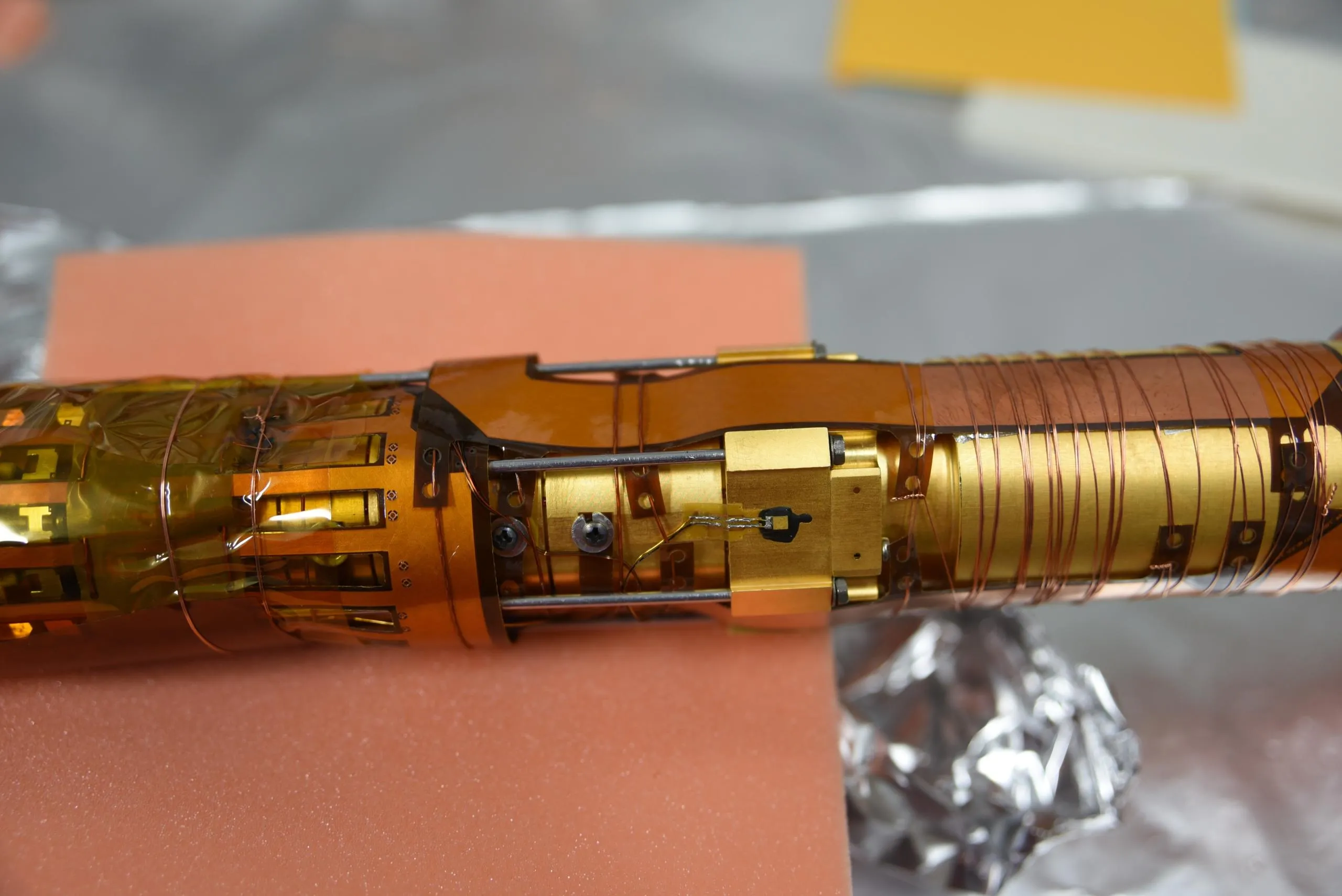
Installation of the 2016 Penning Trap
Installation of the 2016 Penning Trap Theses are some pictures of the Installation of the Penning Trap, that went into ALPHA 2.
-
360 Panoramas from the AD Hall
360 Panoramas from the AD Hall Theses are some of the pictures from the AD Hall where ALPHA is located at CERN. Click here for a Virtual Tour! For the full gallery, please visit CDS.
-
The ALPHA-g Antihydrogen Gravity Magnet System
The ALPHA-g experiment at CERN aims to perform the first-ever precision measurement of the weight of antimatter, using antihydrogen atoms confined in a magnetic trap. In the measurement, anti-atoms are allowed to escape through either a lower or an upper port in the trap, the up-down balance of which depends on gravity and the trap
-
Investigation of the fine structure of antihydrogen
At the historic Shelter Island Conference on the Foundations of Quantum Mechanics in 1947, Willis Lamb reported an unexpected feature in the fine structure of atomic hydrogen: a separation of the 2S1/2 and 2P1/2 states. The observation of this separation, now known as the Lamb shift, marked an important event in the evolution of modern
