
Tag: Positrons
-
Sympathetic cooling (pbar)
Sympathetic cooling (pbar) The positron – the other component of the antihydrogen atom – also needs to be cooled as much as possible before being used for antihydrogen formation, as we have observed that the temperature of the positrons strongly influences the temperature of the antihydrogen we produce, which directly influences how much antihydrogen we
-
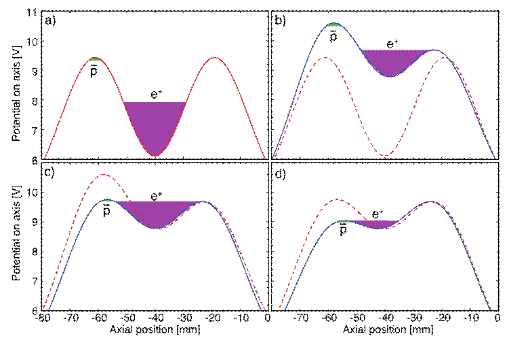
1. Mixing of Antiprotons & Positrons
1. Mixing of Antiprotons & Positrons Antihydrogen is synthesized by merging ensembles of antiprotons and positrons. As the goal is to trap them, it is of utmost importance that the antihydrogen synthesized is cold enough to be trapped. The magnetic trap used to trap them is at best around 50 micro-electron-volt deep; this is equivalent
-
Positron Accumulation
Positron Accumulation The Positron Accumulator has a trap composed of a 0.14 T solenoid magnet and 7 cylindrical electrodes. The first two electrodes are narrow, with a diameter of 12.7 mm each. The third electrode has a diameter of 30.5 mm, and the last four electrodes are the widest, at 200.7 mm each. Pure nitrogen
-
Positron Source
Positron Source Positrons in ALPHA originate from a radioactive isotope of sodium Na-22. The Na-22 source is manufactured at iThemba Labs in Cape Town, South Africa and then shipped in a special container to CERN following international protocols for the transport of radioactive substances. Na-22 has a long half-life of 2.6 years, and therefore emits