
Tag: Manipulation of antiprotons, positrons and other charged particles
-
Laser Cooling (Be+)
Laser Cooling (Be+) The Doppler effect exists for more types of waves than just sound waves. This also occurs with light, where a moving observer will see a difference in the frequency of light compared to a stationary observer. This effect occurs when atoms are moving with respect to laser light, which is light of
-
Sympathetic cooling
Sympathetic cooling Sympathetic cooling is a mechanism where two different species are mixed together in the same region of our trap, and will therefore exchange energy via Coulomb interactions. If you are able to reduce the average kinetic energy of one species, the other species will cool down as well. In this context, ‘cooling’ is
-
SDR-EVC
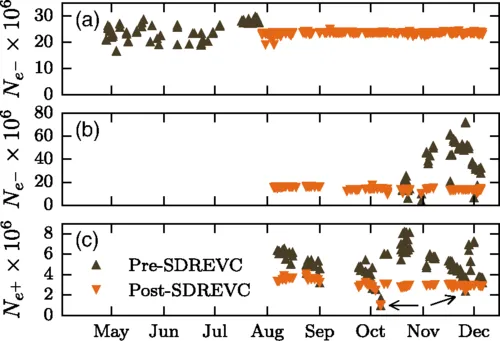
SDR-EVC Efficient trapping of antihydrogen requires very precise and repeatable manipulation of the antiproton and positron plasmas from which the antihydrogen is synthesized. We were able to greatly increase the efficiency after we developed a new process, SDR-EVC, for stabilizing our positron plasmas. In SDR-EVC, we apply a rotating electric field to the plasma, which
-
Evaporative Cooling
Evaporative Cooling Evaporative cooling is the mechanism that cools a hot cup of coffee. The most energetic molecules are the ones most likely to escape as steam, and in the process lowering the average kinetic energy (and therefore the temperature) of the coffee. The same thing will happen with particles in a trap. If the
-
Cyclotron Cooling
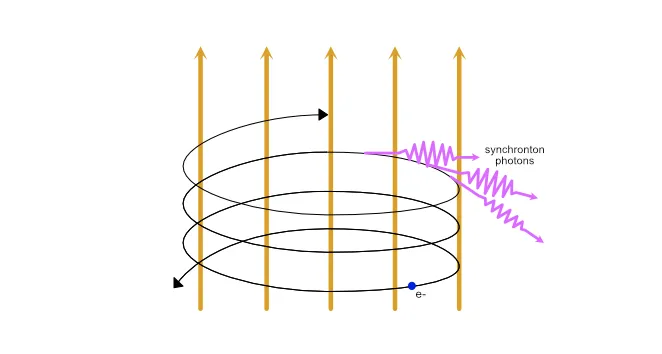
Cyclotron Cooling When a charged particle is accelerated it emits energy in the form of electromagnetic waves. In a Penning trap, charged particles are on circular orbits, known as cyclotron orbits, around the magnetic fields lines. Because they are undergoing circular motion, they are constantly accelerating and therefore losing energy by emitting electromagnetic waves. This
-
Rotating Wall
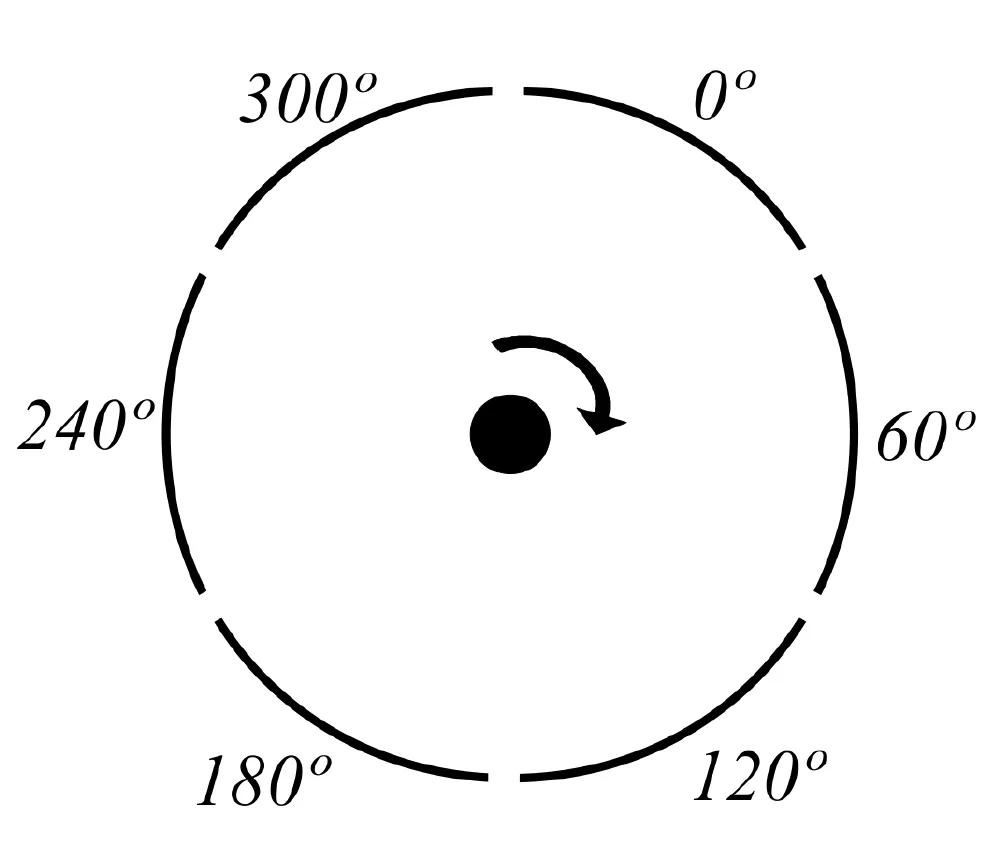
Rotating Wall The Rotating Wall is a technique used in the ALPHA apparatus that allows us to confine a nonneutral plasma for an arbitrary amount of time and to control the radius, density and rotation frequency of the plasma column. In principle, a nonneutral plasma (positrons or electrons or antiprotons or ions) confined in a
-
Ioffe-Pritchard Trap
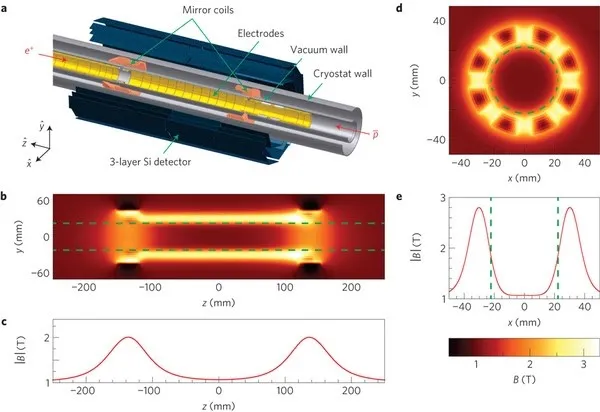
Ioffe-Pritchard Trap The ALPHA magnetic trap is a variant of a type of atom trap called an ‘Ioffe trap’. a A schematic view of the ALPHA trap. Radial and axial confinement of antihydrogen atoms is provided by an octupole magnet (not shown) and mirror magnets, respectively. Penning trap electrodes are held at ~9 K, and
-
Penning Trap
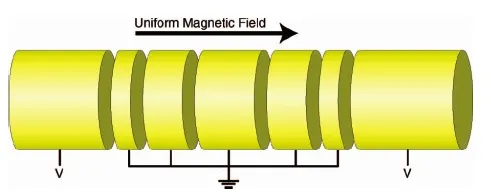
Penning Trap It is a basic and unavoidable fact in the antimatter business that in order to produce antihydrogen, antiprotons and positrons must be mixed. So, ALPHA must have the ability to confine and manipulate charged plasmas with reasonable efficiency and at cryogenic temperatures to boot! This is accomplished in ALPHA through the use of