
Tag: Antiprotons
-

Measurements of Penning-Malmberg trap patch potentials and associated performance degradation
Antiprotons created by laser ionization of antihydrogen are observed to rapidly escape the ALPHA trap. Further, positron plasmas heat more quickly after the trap is illuminated by laser light for several hours. These phenomena can be caused by patch potentials—variations in the electrical potential along metal surfaces. A simple model of the effects of patch
-
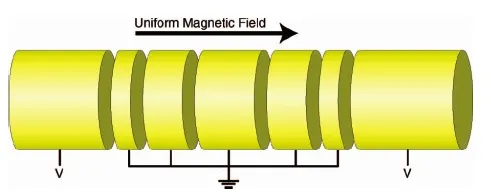
Penning Trap
Penning Trap It is a basic and unavoidable fact in the antimatter business that in order to produce antihydrogen, antiprotons and positrons must be mixed. So, ALPHA must have the ability to confine and manipulate charged plasmas with reasonable efficiency and at cryogenic temperatures to boot! This is accomplished in ALPHA through the use of
-
1. Get Antiprotons
1. Get Antiprotons Related physics: Antimatter, Antiproton Related equipment: AD
-
3. Stacking
3. Stacking Once trapped it is now possible to repeat the procedures of mixing and trapping, but without de-energising the magnetic trap after each repeat. This means that one can continuously add new antihydrogen atoms to the trap, losing only a few due to their naturally short lifetime in a world of normal matter. The
-
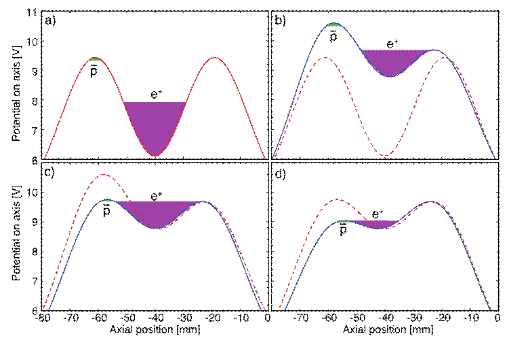
1. Mixing of Antiprotons & Positrons
1. Mixing of Antiprotons & Positrons Antihydrogen is synthesized by merging ensembles of antiprotons and positrons. As the goal is to trap them, it is of utmost importance that the antihydrogen synthesized is cold enough to be trapped. The magnetic trap used to trap them is at best around 50 micro-electron-volt deep; this is equivalent
-
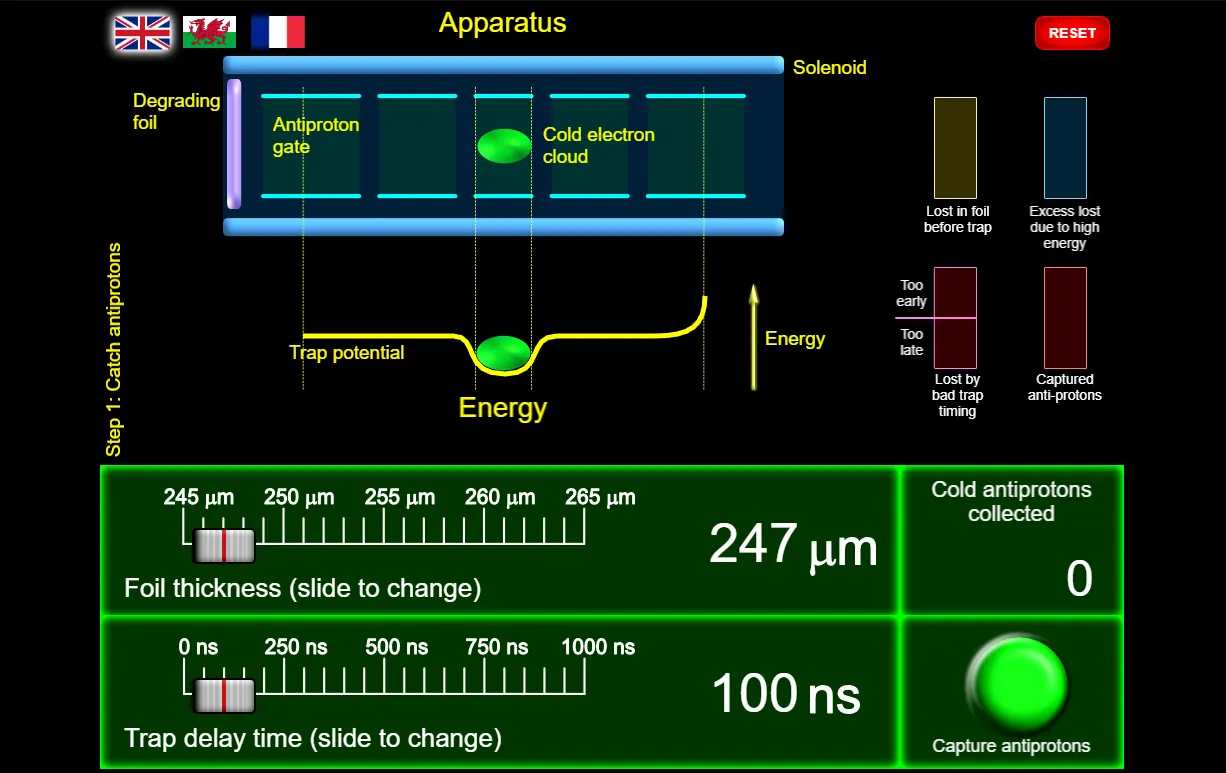
Antiproton Capture
Antiproton Capture In order to give you an idea of how antihydrogen is actually made and trapped, we have made a small game that takes you through some key steps. You must succeed at each step to progress to the next. In the first part you need to capture antiprotons from the AD. The animation
-
Antiproton Source
Antiproton Source From Beam to Particle Why decelerate? In order to make (anti)matter from “nothing” you need as a minimum the energy given by Einstein’s famous formula E=mc2. In practice you need somewhat more to make the process efficient. Antiproton production therefore requires high energy (10s of GeV) collisions (proton beam onto a metal target),