
Tag: Antihydrogen Synthesis & Trapping
-

3. Stacking
3. Stacking Once trapped it is now possible to repeat the procedures of mixing and trapping, but without de-energising the magnetic trap after each repeat. This means that one can continuously add new antihydrogen atoms to the trap, losing only a few due to their naturally short lifetime in a world of normal matter. The
-
2. Trapping of Antihydrogen
2. Trapping of Antihydrogen Antihydrogen is electrically neutral, so it cannot be confined with the combination of electric and magnetic fields that confine the charged positrons and antiprotons. Antihydrogen does however have a magnetic “dipole moment”, which means that it can be confined using an arrangement of magnetic fields. The dipole moment is a very
-
1. Mixing of Antiprotons & Positrons
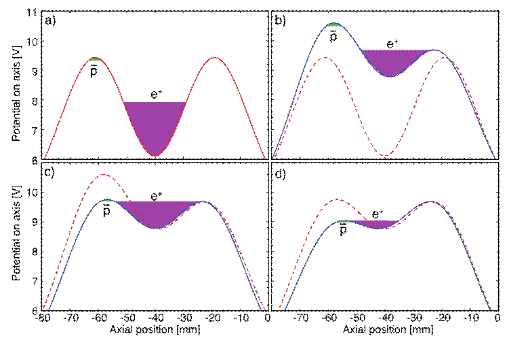
1. Mixing of Antiprotons & Positrons Antihydrogen is synthesized by merging ensembles of antiprotons and positrons. As the goal is to trap them, it is of utmost importance that the antihydrogen synthesized is cold enough to be trapped. The magnetic trap used to trap them is at best around 50 micro-electron-volt deep; this is equivalent