
MANIPULATION OF ANTIPROTONS, POSITRONS AND OTHER CHARGED PARTICLES
In ALPHA, charged particles are trapped using a Penning-Malmberg trap. The most commonly trapped particles in our trap are the antiproton and the positron – the two ingredients to produce antihydrogen. Antihydrogen is electrically neutral, so it cannot be confined with the electric fields used to confine the charged positrons and antiprotons. Instead we use an ‘Ioffe-Pritchard trap’.
Also On Manipulation of antiprotons, positrons and other charged particles
-

Microwave measurements (hyperfine)
Microwave measurements (hyperfine) The ground state hyperfine splitting (GSHFS) is one of the best measured transitions in hydrogen and plays an important role in astrophysics (where it is known as the 21-cm line) and in tests of fundamental physics. In a magnetic trap, the ground state of antihydrogen (and hydrogen) is split into four hyperfine…
-
Laser Cooling (Be+)
Laser Cooling (Be+) The Doppler effect exists for more types of waves than just sound waves. This also occurs with light, where a moving observer will see a difference in the frequency of light compared to a stationary observer. This effect occurs when atoms are moving with respect to laser light, which is light of…
-
Sympathetic cooling (pbar)
Sympathetic cooling (pbar) The positron – the other component of the antihydrogen atom – also needs to be cooled as much as possible before being used for antihydrogen formation, as we have observed that the temperature of the positrons strongly influences the temperature of the antihydrogen we produce, which directly influences how much antihydrogen we…
-
Sympathetic cooling (e-)
Sympathetic cooling (e-) After catching antiprotons from the Antiproton Decelerator, they are still too energetic and hot (around 30 million Kelvin) to be used for antihydrogen formation, as we want the antihydrogen we produce to be as cold as possible so it is easier to trap. In order to cool them, they are mixed with…
-
Sympathetic cooling
Sympathetic cooling Sympathetic cooling is a mechanism where two different species are mixed together in the same region of our trap, and will therefore exchange energy via Coulomb interactions. If you are able to reduce the average kinetic energy of one species, the other species will cool down as well. In this context, ‘cooling’ is…
-
SDR-EVC
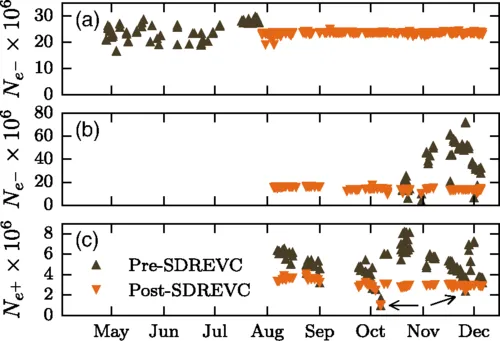
SDR-EVC Efficient trapping of antihydrogen requires very precise and repeatable manipulation of the antiproton and positron plasmas from which the antihydrogen is synthesized. We were able to greatly increase the efficiency after we developed a new process, SDR-EVC, for stabilizing our positron plasmas. In SDR-EVC, we apply a rotating electric field to the plasma, which…
-
Evaporative Cooling
Evaporative Cooling Evaporative cooling is the mechanism that cools a hot cup of coffee. The most energetic molecules are the ones most likely to escape as steam, and in the process lowering the average kinetic energy (and therefore the temperature) of the coffee. The same thing will happen with particles in a trap. If the…
-
Cyclotron Cooling
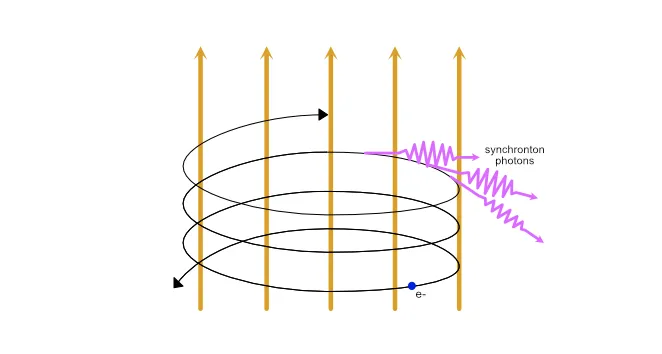
Cyclotron Cooling When a charged particle is accelerated it emits energy in the form of electromagnetic waves. In a Penning trap, charged particles are on circular orbits, known as cyclotron orbits, around the magnetic fields lines. Because they are undergoing circular motion, they are constantly accelerating and therefore losing energy by emitting electromagnetic waves. This…